

February 5, 2026
•
5 min read
How to Retire in Costa Rica: Your Pura Vida Roadmap
Learn how to retire in Costa Rica with this complete guide to visas, cost of living, healthcare, housing, and settling into the Pura Vida lifestyle.
Justin Barsketis
Insurance Expert

Retiring in Costa Rica isn't just about changing your address; it's about embracing a whole new way of living, one where natural beauty, affordability, and a genuinely welcoming culture are part of the daily routine. Many people get there with the popular Pensionado visa, which requires a steady $1,000 monthly income. From there, you can budget for a very comfortable life that typically costs between $2,000-$3,000 per month, all while having access to the country's excellent dual public-private healthcare system.
Why Choose Costa Rica for Your Retirement

You've probably heard the phrase 'Pura Vida' (or 'pure life') tossed around. For the thousands of expats who now call Costa Rica home, it's not just a catchy motto; it's the reality of a slower, more intentional pace of life. This little Central American gem consistently tops the lists of the best retirement destinations, and the reasons go far beyond its stunning volcanoes and pristine beaches.
The journey to retiring in Costa Rica really starts with understanding its core appeal. It's a country that offers a rare mix of political stability - it famously abolished its army back in 1948 - and a deep-seated respect for nature. This translates into a secure and serene environment where your retirement dollars can stretch much further without you having to sacrifice your quality of life.
The Core Appeal for Retirees
The country's allure for retirees is built on a few key pillars. These aren't just vague concepts; they're practical advantages that can transform a beautiful vacation spot into a livable, long-term home. From a top-tier healthcare system to a culture that genuinely welcomes foreigners, the benefits are tangible.
Think about these core attractions:
- Affordable Cost of Living: Your monthly budget can be significantly lower than in the US or Europe. This is especially true for essentials like groceries, healthcare, and property taxes, which are a remarkably low 0.25%.
- High-Quality Healthcare: Costa Rica boasts a dual healthcare system. You'll have access to both the public system (known as the Caja) and excellent private options, all known for their quality and affordability.
- Welcoming Expat Communities: You won't be going it alone. There are established communities of retirees in popular regions like the Central Valley and Guanacaste, making it easy to build a new social network.
- Political and Economic Stability: As one of Latin America's most stable democracies, Costa Rica provides a secure environment for both living and investing.
This blend of benefits isn't just word of mouth. Costa Rica consistently ranks as a premier retirement haven, reflecting its ability to deliver on the promise of a better, more affordable lifestyle for expats.
This isn't just a recent trend, either. Global indexes confirm the country's high standing year after year. Costa Rica ranked third in International Living's 2026 Annual Global Retirement Index with an impressive score of 87.6 out of 100, trailing only Greece and Panama.
This perennial favorite status is a testament to its compelling mix of natural beauty, stability, and value. For Americans and Canadians, the visa-free entry for up to 180 days gives you plenty of time to explore and find the perfect community before you commit. To see how Costa Rica stacks up against other top destinations, check out our guide to the best countries to retire.
To give you a quick snapshot, here's a rundown of the key details.
Costa Rica Retirement at a Glance
This table breaks down the essential information you'll need, offering a quick reference for the most important requirements and features of retiring in Costa Rica.
| Key Aspect | Requirement or Detail | Notes for Retirees |
|---|---|---|
| Residency Visa | Pensionado Program: Requires a minimum $1,000/month income from a pension or Social Security. | This is the most popular route for retirees. Other options include the Rentista and Inversionista visas. |
| Cost of Living | $2,000–$3,000 per month for a comfortable lifestyle for a couple. | Your budget will vary based on location (coastal vs. Central Valley) and lifestyle choices (dining out, travel). |
| Healthcare | Mandatory enrollment in the public system (Caja). Private insurance is a popular supplement. | The Caja system is comprehensive, but many expats opt for private insurance for faster access to specialists. |
| Housing | Renting is common initially. Foreigners can legally own property. | It's wise to rent for 6-12 months to explore different areas before buying. No fideicomiso (bank trust) needed. |
| Taxes | Territorial tax system. Foreign income, like pensions and investments, is not taxed. | This is a major financial benefit. You only pay taxes on income earned within Costa Rica. |
| Safety & Stability | Stable democracy with no standing army since 1948. Generally safe for expats. | Petty crime exists, as in any country. Standard precautions are recommended, especially in tourist areas. |
This table provides a great starting point, but as you'll see in the sections that follow, the real magic is in the details of planning your move and embracing the Pura Vida lifestyle.
Securing Your Long-Term Residency
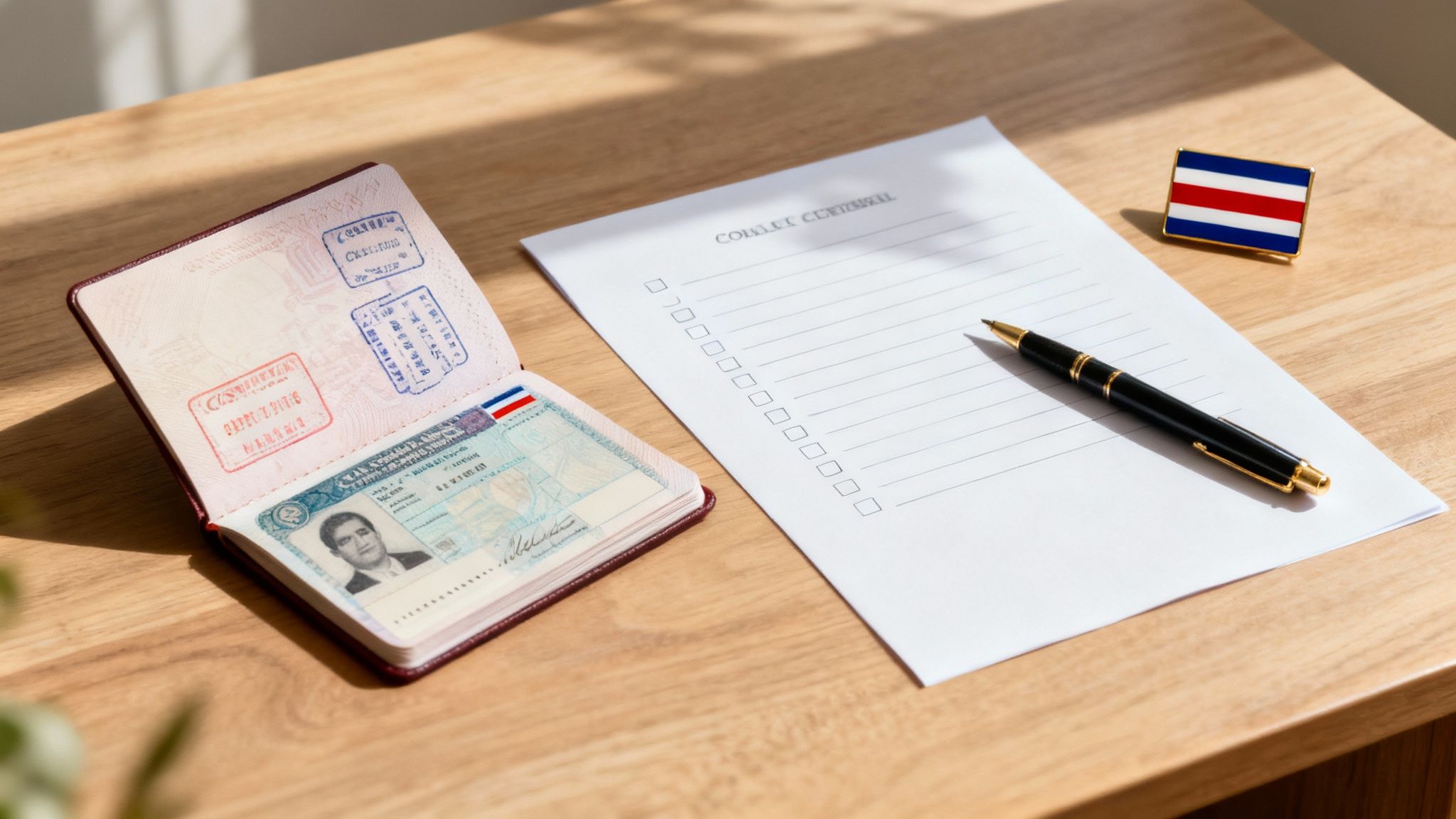
Alright, let's talk about the first major hurdle in your retirement journey: moving past that initial 180-day tourist visa. Getting temporary residency isn't just a suggestion; it's a must. This is the step that truly transforms you from a visitor into a resident, giving you access to things like a local driver's license, bank accounts without a fuss, and the public healthcare system.
While it does involve a fair bit of paperwork, thousands of expats have successfully navigated this process. It's a well-trodden path.
For most retirees, the go-to option is the Pensionado Program. It's tailor-made for people with a steady, lifetime pension and is one of the biggest draws for retiring in Costa Rica. It offers a clear, achievable route to living here legally.
The Popular Pensionado Visa Explained
The Pensionado visa is the gold standard for retirees because its financial requirement is so straightforward. To qualify, you need to prove you have a guaranteed monthly income of at least $1,000 USD coming from a certified, lifetime pension.
So, what does Costa Rica consider a "pension"?
- Social Security: Your payments from the U.S. Social Security Administration are a perfect match.
- Government Pensions: This covers federal, state, or local government retirement plans.
- Military Pensions: Benefits from military service absolutely count.
- Private Company Pensions: A certified lifetime pension from a private corporation is also eligible.
One crucial point: income from sources like IRAs, 401(k)s, or personal investments doesn't count for the Pensionado program. If that's where your retirement funds are, you'll want to look at the Rentista visa instead.
Alternative Residency Paths for Retirees
What if you don't have a traditional pension but have solid savings or investment income? No problem. Costa Rica has other flexible options designed for different financial situations.
-
Rentista Program: This is your route if you have consistent investment income or significant savings. You'll need to show a stable, unearned monthly income of $2,500 USD for at least two years. Alternatively, you can make a deposit of $60,000 into an approved Costa Rican bank.
-
Inversionista (Investor) Program: If a major investment is part of your retirement plan, this program could be a great fit. It requires a minimum investment of $150,000 USD in things like Costa Rican real estate, an approved local business, or even certain sectors like reforestation.
No matter which path you choose, the goal is the same: to establish yourself as a legal temporary resident. After three years of holding temporary residency under any of these programs, you become eligible to apply for permanent residency, a significant step toward making Costa Rica your forever home.
Gathering Your Essential Documents
I won't sugarcoat it - the residency application is a document-heavy process that demands attention to detail. Getting your paperwork organized from the get-go will save you a world of headaches. Remember, any document from your home country must be authenticated with an apostille and then officially translated into Spanish.
Here's a basic checklist of what you'll need to start gathering:
- Application Letter: A formal letter stating why you're seeking residency.
- Proof of Income: The official letter from your pension provider or bank certifying your income.
- Criminal Background Check: A federal-level check (like an FBI report in the U.S.) that's been issued within the last six months.
- Birth Certificate: An official, certified copy for you and any dependents joining you.
- Marriage Certificate: Required if your spouse is applying with you.
- Passport Photos: A few recent, passport-sized photos.
- Fingerprint Registration: You'll do this in Costa Rica at the Ministry of Public Security.
To ensure your paperwork meets the strict official standards, you'll likely need professional Immigration Document Translation services.
From the day you submit your application to the moment you have your residency card (cédula) in hand, the process can take anywhere from 6 to 18 months. Given the potential for bureaucratic snags, hiring a reputable Costa Rican immigration attorney isn't just a good idea; it's practically essential. An experienced lawyer makes sure everything is filed correctly, keeps the process moving, and handles any issues that pop up, making the investment well worth the peace of mind.
For a wider view on the logistics of moving abroad, our guide on how to retire overseas offers some great additional insights.
Understanding the Real Cost of Living
So, you've heard Costa Rica is "affordable," but what does that actually mean for your wallet month to month? It's one thing to see the numbers, but it's another thing entirely to picture how they translate into a real budget for your new life.
The honest answer is that your cost of living will swing wildly depending on one huge decision: where you decide to plant your roots.
A quiet, relaxed life in the temperate Central Valley comes with a very different price tag than a swanky beachfront condo in a popular Guanacaste surf town. For a lot of people, this is where the dream becomes reality. Retiring in Costa Rica often means a single person can live a genuinely comfortable life on roughly $1,500 to $2,000 per month, which is considerably less than what you'd spend in most parts of the US or UK. Discover more insights about the best countries to retire on expatinsurance.com.
That widely quoted budget of $2,000 to $3,000 per month for a couple isn't just a number to scrape by on; it represents a truly comfortable lifestyle. This covers your housing, all your utilities, groceries, healthcare payments, transportation, and still leaves room for regular entertainment.
Let's actually break down what those costs look like on the ground.
Housing and Utilities: A Tale of Two Regions
Housing is going to be your biggest monthly expense, no question. But it's also the one area where you have the most control. The location you choose changes everything.
-
The Central Valley (Atenas, Grecia, San Ramón): There's a good reason this area is a retiree hotspot. Famous for its "eternal spring" climate, you can find a modern two-bedroom home here renting for about $800 to $1,200 a month. A massive perk is being close to the main international airport and the top-tier private hospitals in San José.
-
The Gold Coast (Tamarindo, Playas del Coco): If your retirement dream is all about ocean views and a buzzing social scene, the Pacific coast is probably calling your name. Just be prepared to pay a premium for it. A similar two-bedroom condo could easily set you back $1,500 to $2,500 per month, and even more during the busy tourist season.
As for utilities like electricity, water, and high-speed internet, they are generally reliable and much more affordable than back in North America. For a couple in a moderately sized home, a typical monthly bill often lands somewhere between $100 to $150. This covers everything - electricity (which can creep up if you're blasting the A/C 24/7), water, trash pickup, and a solid internet connection for all your streaming and video calls with family.
Groceries and Dining Out: The Feria Advantage
Here's where you'll really feel the savings and get an authentic taste of local life. You can definitely find American-style supermarkets like Auto Mercado, which are stocked with all the familiar imported brands you know (but at a higher price). The real secret, though, to eating well on a budget is the local feria, or farmer's market.
A weekly haul from the feria can fill your kitchen with incredible fresh fruits, vegetables, local cheeses, eggs, and meats for just a fraction of what you'd pay back home. Seriously, imagine loading up your bags with tropical fruits, avocados, and fresh produce for only $30 to $50 a week.
Eating out is also a great value. A meal at a soda - a small, family-run eatery - will get you a delicious and massive plate of traditional food (called a casado) for around $6 to $8. If you're going out for a nice dinner for two at a mid-range restaurant, expect to pay about $50 to $70 with drinks.
Sample Monthly Budgets for Retirees in Costa Rica
To give you a clearer picture, let's look at how these numbers might come together in a real-world budget. Your own spending habits will obviously be unique, but this table provides a solid starting point for planning your finances, whether you're aiming for a simple, modest lifestyle or a more comfortable one with extra room for luxuries.
| Expense Category | Modest Budget (Single) | Comfortable Budget (Couple) | Notes & Considerations |
|---|---|---|---|
| Housing (Rent) | $650 | $1,200 | Central Valley prices. Coastal areas could be $500-$1,000+ higher. |
| Utilities | $80 | $150 | Includes electricity, water, internet, and trash. A/C usage will increase this. |
| Groceries | $200 | $400 | Primarily shopping at local ferias and markets. Shopping at US-style stores will raise this by 20-30%. |
| Healthcare (CAJA) | $100 | $210 | Based on a % of reported income (e.g., $1,250 for single, $3,000 for couple). This is a rough estimate. |
| Transportation | $50 | $300 | Single budget assumes public transport. Couple budget includes car expenses (gas, insurance, maintenance). |
| Dining & Entertainment | $150 | $400 | A mix of eating at sodas and mid-range restaurants, plus activities like movies or local events. |
| Personal & Misc. | $120 | $250 | Includes cell phone plans, toiletries, household items, and small personal purchases. |
| Total Estimated Monthly | $1,350 | $2,910 | This is a baseline. Your actual costs will vary based on lifestyle, location, and personal spending habits. |
As you can see, hitting that $2,000 to $3,000 range for a comfortable retirement is entirely realistic. It's not about just getting by; it's about having the financial freedom to truly enjoy your life in Costa Rica, whether that means exploring the country, picking up new hobbies, or simply relaxing on your terrace with a good book.
Other Key Expenses to Factor In
Beyond the big categories, there are a few other costs you absolutely need to build into your budget.
- Transportation: This can be a big one. Owning a car is a significant expense, mostly due to very high import taxes and gasoline prices. A reliable used SUV might cost you anywhere from $15,000 to $25,000. Frankly, many retirees find the public bus system to be so affordable and extensive that they don't even need a car for their daily life.
- Healthcare: As a legal resident, you are required to pay into the public healthcare system, known as the Caja. This contribution will be between 7% and 11% of the monthly income you report on your residency application. A lot of expats also choose to carry private insurance for extra peace of mind and flexibility.
- Property Taxes: If you eventually decide to buy a home, you'll be in for a very pleasant surprise. Costa Rica's annual property tax rate is a shockingly low 0.25% of your property's registered value.
By getting a handle on these real-world costs, you can shift from a vague idea of "affordable" to a solid, actionable financial plan. This is what empowers you to design a retirement that perfectly matches the lifestyle you've been dreaming of, whether it's simple and quiet or active and full of adventure.
A Guide to Healthcare and Wellness

Let's talk about something that's on every retiree's mind: healthcare. It's a major factor in choosing a retirement spot, and frankly, it's an area where Costa Rica absolutely shines. Peace of mind is priceless, and the country's dual healthcare system is a huge reason so many expats feel secure and well-cared for here.
This isn't just about having good doctors nearby. It's about understanding a system that offers a practical, affordable mix of public and private options. Getting a handle on how this works is a crucial step in your retirement planning, so you can build a health strategy that gives you total confidence. For a broader look at how different countries handle expat healthcare, read our guide to health insurance when living abroad.
The Public System: La Caja
Once you become a legal resident, you're required to join the public healthcare system, formally known as the Caja Costarricense de Seguro Social (CCSS), but everyone just calls it the "Caja." Think of it less as a requirement and more as a massive benefit.
Membership gets you comprehensive medical care. Everything from a routine doctor's visit and prescriptions to major surgeries is covered, with no deductibles or co-pays.
Your monthly contribution is a percentage - usually between 7% and 11% - of the income you declared on your residency application. For someone on the popular Pensionado visa, this often translates to a surprisingly low monthly fee for complete coverage. And the quality of care is high, consistently ranked among the best in Latin America.
Of course, no system is perfect. The main drawback to the public system is the wait times for specialist appointments and non-emergency procedures. The care is excellent when you get it, but the bureaucracy can feel sluggish. It's a common trade-off you see in universal healthcare systems all over the world.
World-Class Private Healthcare
This is where Costa Rica's setup really works to your advantage. Running parallel to the public Caja is a robust network of modern, private hospitals and clinics that are genuinely world-class.
You'll find state-of-the-art equipment and plenty of English-speaking doctors, many of whom trained in the U.S. or Europe. Best of all, you get immediate access to specialists without the long waits.
The real kicker is the cost. It's a tiny fraction of what you'd pay back in the States. A consultation with a top specialist might run you $80-$100. Major procedures often cost 50-70% less than they would in the US. This affordability makes private care a go-to option for many expats, whether for a quick check-up or to bypass a queue for a specific treatment. For a closer look at the numbers, you can explore detailed medical cost comparisons between Costa Rica and the US.
The smartest strategy, and the one most expats use, is a hybrid approach. Rely on the affordable, comprehensive Caja for your baseline needs like prescriptions and routine care. Then, pay out-of-pocket or use private insurance for specialist visits or anytime you need faster service.
The Role of International Health Insurance
For the ultimate safety net, many retirees add a third layer: an international health insurance plan. This gives you maximum flexibility and is the final piece of the puzzle for total peace of mind.
Here's what a good international plan offers:
- Complete Choice: You have the freedom to see any doctor or go to any hospital you want, public or private, anywhere in Costa Rica.
- Global Coverage: This is a big one. Your insurance isn't just for Costa Rica. It covers you when you travel to see family back home or take a trip to another country.
- Emergency Evacuation: Most plans include medical evacuation coverage. If something serious happens, this benefit can transport you to your home country or the nearest top-tier medical facility, which is an invaluable comfort.
This three-tiered approach is the gold standard for healthcare planning in Costa Rica. You have the Caja as your foundation, the option to pay for quick private care out-of-pocket, and a powerful international policy for major events. It's a combination that ensures you're covered for absolutely anything, without draining your retirement savings.
Finding Your Home and Settling In

This is where the dream starts to feel real. Choosing where you'll live is easily one of the most exciting parts of the whole adventure, setting the tone for your day-to-day life in Costa Rica.
Are you picturing a mountainside home with cool, fresh breezes? Or maybe a beachfront condo where the sound of the waves lulls you to sleep? The country's incredible diversity means there's a perfect spot for just about everyone.
Exploring Popular Expat Regions
Where you plant your roots will have the biggest impact on your lifestyle and your budget. Luckily, Costa Rica has several well-established expat hubs that can make the transition much smoother.
- Atenas and Grecia (Central Valley): These towns are famous for what many call the "world's best climate" - a peaceful, spring-like vibe all year round. It's a slower pace of life but with the huge advantage of being close to San José's top-tier hospitals and the international airport.
- Tamarindo and Playas del Coco (Guanascaste): If your retirement vision involves lots of sun, socializing, and activity, the "Gold Coast" is calling your name. These are vibrant beach towns known for their stunning Pacific coastline, surf culture, and a buzzing network of expats, restaurants, and modern conveniences.
- Dominical and Uvita (Southern Zone): For those looking to truly unplug and connect with nature, this region is pure magic. It's much quieter and more laid-back, defined by lush rainforests that tumble right down to the sea, unbelievable wildlife, and a community focused on wellness and eco-living.
To Rent First or Buy Now
This is the age-old question for anyone planning a move abroad, and the advice from nearly every seasoned expat is refreshingly simple: rent first. Seriously.
Give yourself at least six to twelve months renting in an area you think you'll love. This trial period is invaluable. You'll get to experience the different seasons (especially the rainy season from May to November), learn the real dynamics of a neighborhood, and confirm that a place truly fits before making a massive financial commitment.
It also gives you the freedom to explore other towns if your first choice doesn't feel quite right, all without the headache of trying to sell a property.
Giving yourself a year to rent isn't a delay; it's a strategic investment in your long-term happiness. It's the single best way to ensure the spot you fall in love with on vacation is also the place you want to call home.
The Logistics of Your Big Move
Once you've zeroed in on a general location, it's time to get into the nitty-gritty. These are the details that can feel a bit overwhelming, but if you tackle them one by one, the process is completely manageable.
Shipping Your Belongings and Pets Moving your life in boxes across borders requires a reputable international shipping company that knows its way around Costa Rican customs. Be ready for the process to take several weeks, and expect to pay import taxes on newer items.
For pet lovers, Costa Rica is very welcoming! You'll need to work with a pet relocation service and get all vaccination records and health certificates in order well ahead of time. Our guide to moving to Costa Rica dives much deeper into these crucial logistics. You may also find our moving abroad checklist helpful as you prepare.
Opening a Bank Account Once you're a legal resident with your cédula (residency card), opening an account at a state-owned bank like Banco de Costa Rica (BCR) or Banco Nacional is pretty straightforward. Many banks will also let you open a simplified account as a tourist using just your passport, though it might come with deposit limits. This is a vital first step for handling local bills and expenses.
Getting a Costa Rican Driver's License Your home country's driver's license works just fine as long as your tourist visa is valid. But as soon as you get your residency card, you are required to get a Costa Rican license. The process is called homologación and involves a quick medical exam and presenting your valid license and new cédula. It's a relatively simple step that officially makes you a local driver.
Common Questions About Retiring in Costa Rica
As you start getting serious about the move, the bigger picture gives way to specific, practical questions. It's only natural. This is where we tackle the common concerns we hear from folks on the brink of making their Costa Rican retirement a reality.
Think of this as the final once-over, clearing up any lingering doubts you might have about taxes, safety, language, and finding your people.
Will My U.S. Retirement Income Be Taxed?
This is often one of the first questions people ask, and for good reason. The answer is a huge part of Costa Rica's appeal for American retirees. Simply put, Costa Rica uses a territorial tax system.
What does that mean for you? It means you're only taxed on income generated inside Costa Rica. Money that comes from foreign sources is generally not touched by the Costa Rican government.
This includes your most common retirement income streams:
- Social Security payments
- Private or government pensions
- Withdrawals from your 401(k)s or IRAs
- Investment income from abroad
All that is typically off-limits to Costa Rican tax authorities, which can make a massive difference in your yearly budget. Of course, as a U.S. citizen, you're still on the hook for filing a federal tax return with the IRS each year, no matter where you call home.
How Safe Is Costa Rica for Expats?
By and large, Costa Rica is the safest country in Central America. It's a stable democracy, famously has no army, and the culture is overwhelmingly peaceful. Most expats I've spoken with feel incredibly safe in their day-to-day lives, especially within the established retiree communities sprinkled throughout the Central Valley and along the coasts.
That's not to say it's a crime-free utopia. Like anywhere in the world, you have to be smart. Petty theft - think a bag snatched from a restaurant chair or a car break-in - can happen, especially in busy tourist spots or big cities like San José.
The trick is to use the same common sense you would back home. Don't leave your laptop sitting on the passenger seat, be mindful of your surroundings in a crowded market, and make sure your house is locked up. Taking these basic precautions is really all it takes to enjoy a peaceful and secure retirement here.
Do I Need to Speak Spanish Fluently?
Honestly, you can get by with just English in the major expat bubbles like Tamarindo, Escazú, or Atenas. But "getting by" is one thing; truly living here is another. Learning even a little bit of Spanish will change your entire experience for the better.
It's not just about making life easier; it's about showing respect and building real connections.
Making an effort to speak the language transforms everyday errands - like a trip to the local feria (farmer's market) or getting a leaky faucet fixed - from a challenge into a pleasant interaction. More than that, Costa Ricans genuinely light up when they see you trying. It shows you're not just a visitor; you're invested in being part of the community.
You don't have to aim for fluency right away. Start small with greetings, numbers, and a few key phrases. Countless expats take local classes or just fire up a language app on their phone. You'll be amazed at how far a little effort goes.
How Can I Connect With Other Expats?
One of the best parts about retiring to Costa Rica is the built-in support system. You're not blazing a new trail here; thousands of expats have already paved the way, creating vibrant and welcoming communities all over the country.
Plugging into these networks is easier than you think.
- Jump on Facebook: This is your number one resource. Search for groups like "Expats in Costa Rica" or get specific with town names like "Grecia Gringos" or "Tamarindo Expats." They are treasure troves of advice, social invites, and answers to just about any question you can dream up.
- Show Up in Person: Most areas with a solid expat crowd have weekly farmers' markets, volunteer groups, and clubs for every hobby imaginable - from pickleball and yoga to hiking and book clubs.
These groups are invaluable. One day you'll be asking for a recommendation for a good mechanic, and the next you'll be meeting new friends for dinner. It makes the whole transition feel less like a leap into the unknown and more like coming home.
Healthcare is a critical step in your retirement planning, and getting it right means you can fully relax into your new life. At Expat Insurance, we specialize in finding the perfect health coverage to give you complete peace of mind in your new home. Our expert advisors compare plans from top international insurers to match your needs and budget, ensuring you're protected from day one. Get your free, no-obligation quote today at Expat Insurance and take the guesswork out of securing your health in paradise.
Justin Barsketis
Insurance Expert & Writer
Justin is an insurance guru that loves digital marketing. As our founder Justin manages our business development programs and MGA network. Please don’t hesitate to contact him if you are not getting the attention you deserve.
