

August 6, 2026
•
5 min read
The Most Common Scam in Medellín: How Dating Apps and Burundanga Target Foreigners
Medellín's most common scam lures foreigners through dating apps, then uses burundanga (scopolamine) to drug and rob them. How it works and how to stay safe.
Justin Barsketis
Insurance Expert
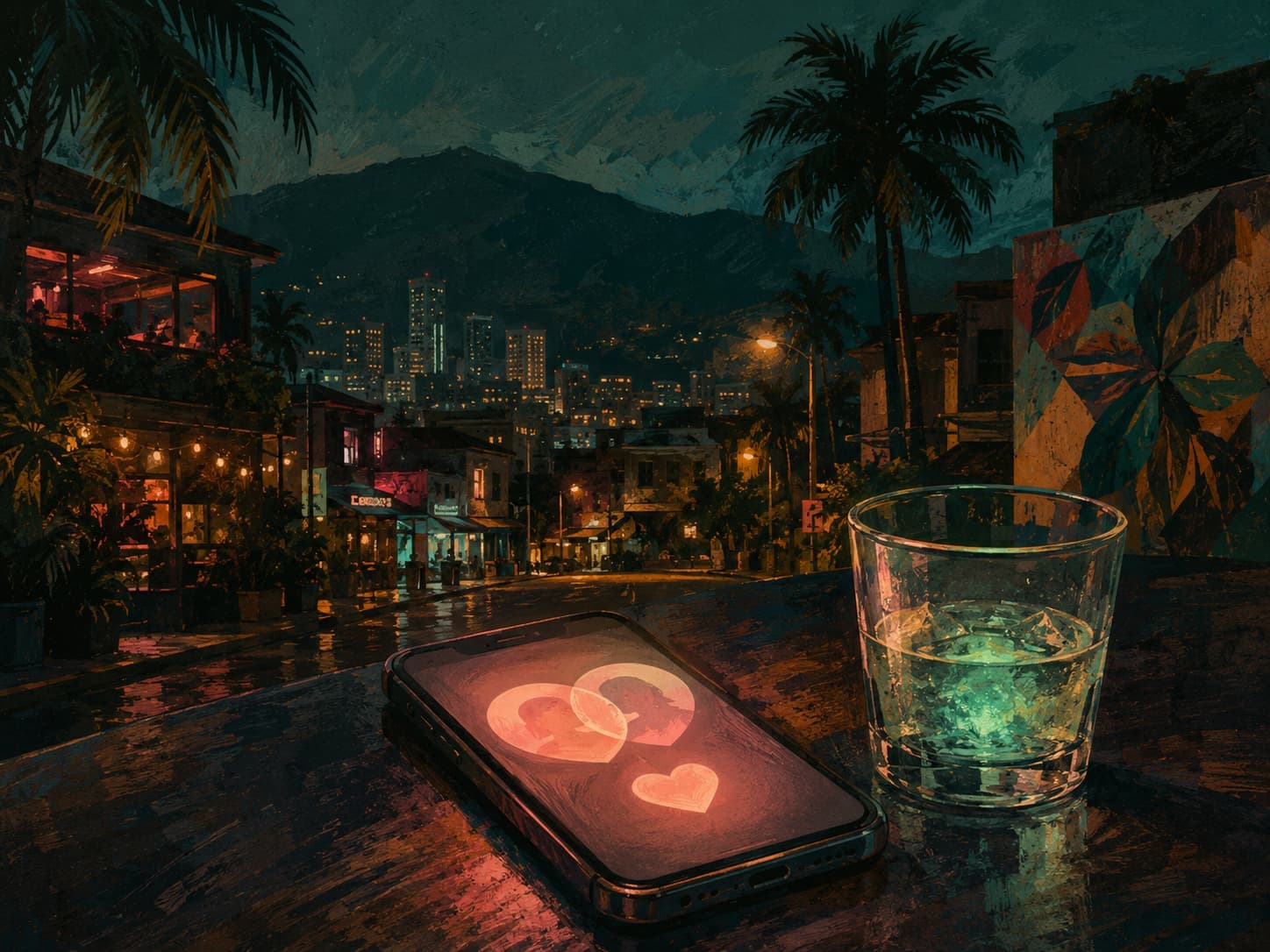
We recently helped a friend file a police report in Medellín. He had matched with someone on a dating app, invited them back to his apartment, accepted a drink, and woke up hours later on his own bed with his phone, his laptop, his wallet, and his peace of mind gone. He was one of the lucky ones. He woke up at all. This is the single most common way that foreigners get robbed in Medellín right now, and almost nobody arrives in the city expecting it to happen to them. That gap between what travelers expect and what actually happens is exactly where criminals make their money.
This is a difficult article to write, because the honest version of it puts a fair amount of responsibility back on the traveler. We are not going to pretend otherwise. Medellín is a wonderful city full of warm, welcoming people, and the vast majority of visitors have a spectacular time. But there is a specific, well-documented crime pattern here that has killed foreigners, and the best protection against it is not luck. It is vigilance.
*NOTE! Whenever you see text in blue, this is a link that will lead you to another one of our articles or to a trusted source so that you can get more information.
If you are planning to live in, retire in, or spend extended time in Latin America, a short conversation can save you a great deal of grief later. You can schedule a free consultation with one of our brokers to talk through travel and health coverage before you go.
The Most Common Scam in Medellín
Medellín's Most Dangerous Scam – The Dating App Crisis:
Ask any long-term resident of Medellín what the biggest threat to foreigners is today, and you will hear the same answer over and over. It is not the cartels of the Netflix imagination. Pablo Escobar has been dead for more than three decades, and the Medellín Cartel was dismantled a generation ago. The real, present-day danger is far more mundane and far more personal. Criminals use dating apps to lure foreigners into a private setting, drug them, and rob them clean.
The scale of this is not a rumor. In the final two months of 2023, the U.S. Embassy in Bogotá recorded eight suspicious deaths of American citizens in Medellín, several of them linked to online dating apps and drink spiking. Over that same stretch, thefts against foreign visitors in the city jumped by roughly 200 percent, and violent deaths of foreigners rose by nearly 30 percent, according to the Tourism Observatory of Medellín's district personnel office. The pattern was alarming enough that the U.S. State Department issued a formal security alert warning Americans not to use dating apps in Colombia at all.
That warning has not gone away. As of 2026, Colombia remains under a Level 3 "Reconsider Travel" advisory from the U.S. State Department, and the embassy continues to flag dating-app druggings as one of the most serious risks facing foreign visitors. Colombian police have made a string of arrests, including one woman the local press nicknamed "the queen of scopolamine," who was tied to at least eight incidents in which foreigners were drugged and stripped of their valuables in the Parque Lleras area of El Poblado. The arrests are real progress. They have not made the problem disappear.
– Who Gets Targeted and Where –
The victims follow a profile. They are overwhelmingly foreign men, often American, often solo, often in Medellín specifically for the nightlife and the dating scene. The apps involved are the ones everyone already has: Tinder, Bumble, Grindr, and similar platforms. The neighborhoods involved are the ones every tourist gravitates toward: El Poblado, the Parque Lleras bar zone, and the Provenza area, which has become ground zero for drink spiking and dating-app druggings.
The uncomfortable truth is that many of these encounters begin with the victim looking for a casual hookup or a paid arrangement, sometimes both. Sex work is not criminalized in Colombia, and criminal groups know this. They use it as bait. We mention this not to shame anyone, but because pretending the pattern does not exist is how people keep walking into it. The criminals count on foreigners being too embarrassed to report what happened, and it works. The embassy has been explicit that these crimes are massively underreported for exactly that reason.
What Is Burundanga?
Medellín's Most Dangerous Scam – Understanding Scopolamine:
Burundanga is the Colombian street name for scopolamine, a drug you may have heard called "Devil's Breath." It is the chemical at the center of almost every one of these robberies, and it is worth understanding clearly, because both the panic and the myths around it can get in the way of protecting yourself.
Scopolamine is a real, legitimate medication. In tiny, controlled doses it is prescribed for motion sickness and post-surgical nausea, usually as a small patch worn behind the ear. It is derived from plants in the nightshade family, including the borrachero tree, whose seeds contain the alkaloid criminals extract. The plant grows commonly across Colombia, sometimes as an ornamental in gardens, which is part of why the drug is so cheap and available.
In the doses used by criminals, scopolamine does three things that make it nearly perfect for robbery. It causes profound confusion and disorientation. It blocks the brain's ability to form new memories, so victims often cannot recall the perpetrator or the event afterward. And it makes people highly suggestible and compliant, which is why some victims are walked to an ATM or handed over their own belongings without resisting.
– Separating the Myth From the Reality –
You have probably seen the sensational version of this story, the one where a single puff of powder blown in your face turns you into a mindless zombie who hands over everything you own. It is worth being precise here, because the myth actually makes people less safe by making the threat sound like something out of a movie rather than something that happens over a drink.
The pharmacology does not support the "one breath and you lose your free will" story. Scopolamine absorbed through the skin or by casual inhalation is far slower and less reliable than the movies suggest. What is genuinely true is more than frightening enough: when the drug is slipped into a drink, food, or a cigarette, it works within roughly half an hour, it causes dense amnesia and severe confusion, and it strips away a person's judgment and resistance. That is the real mechanism behind these crimes. Not magic powder. A spiked drink you accepted from someone you just met.
There is one more fact that turns robbery into tragedy. Scopolamine has an extremely narrow margin between the dose that sedates and the dose that kills. Criminals are not pharmacists. They are guessing, often mixing the drug with alcohol, which compounds the effect. An overdose can cause respiratory failure, coma, and death. This is precisely why some of these robberies end with a foreigner dead in a hotel room or an apartment rather than merely robbed. The drug that makes the theft easy is the same drug that makes it lethal.
*If something feels wrong after a drink, do not wait it out. Get to a public place, tell staff or a trusted person you have been drugged, and seek medical help immediately. Standard toxicology screens miss scopolamine quickly, so speed matters both medically and for any future report.
How the Scam Actually Works
Medellín's Most Dangerous Scam – The Playbook:
The mechanics are remarkably consistent from case to case, which is part of what makes them possible to defend against once you know them. Here is how the sequence typically unfolds.
First comes the match. Contact begins on a dating app, occasionally on social media. The conversation is warm and moves quickly toward meeting. Sometimes there is more than one person on the other end running the account.
Second comes the meeting. It may start in a bar or restaurant to build trust, or it may skip straight to the invitation. The critical pivot is the move to a private location, almost always the victim's apartment or hotel room. This is the moment the crime becomes possible. In a public place, the criminal has limited options. Behind a closed door, they have all of them.
Third comes the drink. At some point the victim is handed a drink, and the scopolamine goes in. Because it is odorless and tasteless, there is no warning. Within half an hour the victim is confused, compliant, and heading toward unconsciousness.
Fourth comes the robbery. The valuables go first: phone, laptop, wallet, cash, watch, cards. In many cases the thief uses the victim's own compliant state to extract PINs, or walks them to withdraw money, or simply drains accounts and makes purchases on the stolen cards while the victim is unconscious. Our friend's cards were being used before he even woke up.
That is the entire playbook. Notice how much of it depends on one single decision by the victim: inviting a stranger into a private space. Almost every safeguard we will describe below works by attacking that one link in the chain.
Why the Police "Cannot Do Anything"
Medellín's Most Dangerous Scam – The Hard Reality of Reporting:
Here is the part of our friend's story that shocked him the most, and the part every traveler needs to understand before they ever need it. When we helped him file the report, the police were not cruel, but they were blunt. There was, in practical terms, very little they could do.
He had one thing going for him: his phone's location was still visible through Find My. He could see, on a map, roughly where his stolen phone was sitting. He begged them to act on it. The answer was essentially this: we cannot enter a private residence on the basis of a phone-location dot, and we do not have the resources to stake out a device. If you want to recover it, the officers told him, you would have to go there yourself, identify the thief, keep them there, and call 123 so a patrol can come. In other words, he would have to risk his life to get a phone back.
We want to be completely clear about this, because it is the most important safety point in this entire article. Do not do that. Do not go to the location. Do not try to recover the device yourself. The embassy has warned specifically that foreigners who resist or fight back during these crimes are more likely to end up dead. A phone can be replaced in an afternoon. You cannot. The find-my dot is a trap for exactly the adrenaline-fueled instinct our friend had, and following it has gotten people hurt.
– What Reporting Actually Accomplishes –
If the police often cannot recover the item, why report at all? Because the report, called a denuncia in Colombia, does real work even when it does not return your phone.
A denuncia is the official record you will need for an insurance claim. It is what your bank and card issuers will often want when you dispute fraudulent charges. It is what your mobile carrier needs to blacklist the phone by its IMEI number, which turns the stolen device into a far less useful brick and can help if it ever resurfaces in the police database. And if you are a foreigner whose passport was taken, the report is part of the paper trail for getting it replaced. You can read our full guide on how to replace a lost or stolen U.S. passport abroad if that is part of your situation.
So file the report. Bring a Spanish speaker if you can, because you should not assume the officers speak English. Just go in with realistic expectations. The denuncia is a document that protects your finances and your identity going forward. It is very rarely a recovery mission.
– If Your Phone or Passport Is Gone –
Move fast and in this order. Call your bank and card issuers immediately to freeze cards and dispute charges, because with scopolamine robberies the fraud often starts within minutes. Call your mobile carrier to suspend service and blacklist the IMEI. Change the passwords on your email and financial apps from another device, since your phone held the keys to everything. File the denuncia. And if your passport is gone, contact your embassy. Our guide on how to get help from the U.S. Embassy during an emergency walks through what they can and cannot do for you, so you are not learning it in the moment.
A Traveler's First Responsibility Is Vigilance
Medellín's Most Dangerous Scam – Prevention Is the Whole Game:
Colombians have a phrase for the mindset that keeps you safe here: no dar papaya. Literally it means "don't give papaya," and it captures a whole philosophy. If you leave an opportunity sitting out in the open, the thinking goes, you should not be shocked when someone takes it. Locals internalize this from childhood. Foreigners who get into trouble have almost always broken the rule.
We will be honest that dar papaya has a darker edge, because taken too far it shades into blaming victims for crimes that criminals chose to commit. The fault for a drugging always lies with the person who spiked the drink. But as a practical framework for how to move through a city like Medellín, the philosophy is sound. You cannot control whether criminals exist. You can control how much opportunity you hand them. Here is how.
– Rethink Dating Apps Entirely –
The single most effective thing you can do is the hardest for many travelers to hear: seriously reconsider using dating apps in Medellín at all. The State Department's advice was not "use them carefully." It was to avoid them. If you have come to the city specifically for the dating and nightlife scene, understand that you are walking directly into the exact funnel these criminal groups have built. The convenience of the app is the vulnerability.
– Never Move to a Private Location With Someone You Just Met –
If you do use an app despite the warnings, this is the rule that breaks the scam. Meet in a busy public place, and stay there. Do not go back to their place. Do not invite them to yours. Almost every serious case follows the same pivot from public to private, and refusing that pivot removes the criminal's opportunity almost entirely. Our friend's entire ordeal traces back to a single invitation to come upstairs.
– Never Accept an Open Drink You Did Not Watch Being Made –
Only drink sealed, branded beverages, or drinks you watched a bartender pour and that never left your hand or sight. Do not accept a drink poured for you by a new acquaintance. Do not accept food, gum, or cigarettes from a stranger either, since all of these have been used to deliver the drug. If you set a drink down and lost sight of it, abandon it and order a new one.
– Keep Your Life Off Your Phone's Lock Screen –
Assume your phone can be taken. Use a strong passcode, not a four-digit PIN a compliant version of you could be coaxed into revealing. Turn off message previews on your lock screen so a thief cannot see two-factor codes. Do not save banking passwords in ways that unlock with a glance. The goal is that even with the physical device, a thief cannot cascade into your bank and email.
– Tell Someone Your Plans –
If you are meeting anyone new, tell a friend or family member where you are going, who you are meeting, and which app you used. Share your live location with someone you trust. This is standard embassy advice, and it means that if you go dark for a day, someone knows to raise an alarm.
– Blend In and Stay Sober Enough to Notice –
Do not flaunt an expensive watch, camera, or jewelry, especially on a first meeting with someone you met online. Keep enough of your wits about you to notice when something feels off, and act on that feeling immediately. The victims who escape these situations are almost always the ones who left early when their instincts told them to.
Have a Plan Before Anything Goes Wrong
Medellín's Most Dangerous Scam – Preparation and Coverage:
Vigilance is the first layer. A plan is the second. The travelers who come through a theft with the least damage are the ones who set things up before they ever needed them.
Back up your phone and laptop to the cloud before you travel, so a stolen device is an inconvenience rather than the loss of your photos, documents, and work. Keep a photocopy or a secure digital copy of your passport separate from the original. Write down your card issuers' international phone numbers and keep them somewhere that is not your phone. Know your embassy's location and emergency contact before you arrive. Carry a small amount of "give it up" cash so that if you are ever confronted, you can hand something over without a fight.
And think seriously about insurance before you go, not after. This is where preparation and coverage meet, and it is worth understanding what actually applies to your situation.
– Where Insurance Fits In –
Two different products matter here, and people often confuse them. Travel insurance and travel medical insurance are not the same thing, and the difference matters a great deal in a place like Colombia. Our breakdown of the difference between health insurance and travel insurance in Latin America is worth a read before you choose.
On the medical side, a scopolamine overdose is a genuine medical emergency, and emergency care as a foreigner is not free. Travel medical coverage or an international health plan is what stands between you and a very large hospital bill if a drugging goes wrong. If you are living or working remotely from Medellín rather than just passing through, our guide to health insurance for digital nomads covers the longer-term options.
On the property and trip side, many travel insurance policies include some coverage for stolen belongings and emergency assistance, though the limits on electronics are often lower than people expect and a police report is almost always required to claim. If you are unsure whether you even need it, we lay out the case in do I need travel insurance, and we break down the fine print in what does travel insurance cover. The honest summary is that insurance will not un-drug you or un-steal your phone, but it can absorb the medical and financial blow, and that is not nothing when the alternative is a hospital bill in a foreign currency.
Not sure which coverage fits a trip to Colombia? Get a free 1-minute quote here and see your options before you travel.
Frequently Asked Questions
Medellín's Most Dangerous Scam – Your Questions Answered:
– Is Medellín safe to visit in 2026? –
For most travelers who stay within the main tourist areas and use good judgment, yes. Medellín's overall homicide rate has actually fallen below that of several major U.S. cities, and millions of visitors have a wonderful time there every year. The risk we describe in this article is specific and largely avoidable. It concentrates around nightlife, dating apps, and the decision to go somewhere private with a stranger. Avoid that one funnel and your risk drops dramatically. Colombia does remain under a U.S. Level 3 "Reconsider Travel" advisory, so read the current guidance before you go.
– What is the difference between burundanga and scopolamine? –
They are the same thing. Scopolamine is the pharmacological name, and burundanga is the Colombian street name for it. "Devil's Breath" is the sensationalized nickname you will see in headlines. All three refer to the same tropane alkaloid used in these robberies.
– Can you really be drugged just by someone blowing powder in your face? –
This is largely a myth. The overwhelmingly common method is a spiked drink, food, or cigarette that you consume. Casual skin or air exposure is far slower and less reliable than the folklore suggests. Focusing on the movie version can make you drop your guard around the thing that actually gets people, which is accepting a drink from someone you just met.
– The police said they could not recover my phone even with the location. Is that normal? –
Unfortunately, yes. Colombian police generally will not raid a private residence over a phone-location signal, and they rarely have the resources to pursue a single stolen device. What they can do is take your denuncia, the official report you will need for insurance, bank disputes, and blacklisting the phone's IMEI. Do not attempt to recover the device yourself. It is not worth your life.
– Should I use dating apps in Medellín? –
The U.S. State Department's direct advice is to avoid them in Colombia. If you choose to use them anyway, the non-negotiable rules are to meet only in busy public places, never move to a private location with someone new, and never accept a drink you did not watch being made.
Final Thoughts
Medellín's Most Dangerous Scam – Conclusion:
We love Medellín. We are not writing this to scare anyone away from a genuinely beautiful, welcoming city that has transformed itself over the past two decades. We are writing it because our friend is fine, but he did not have to go through what he went through, and because the crime that hit him is both common and almost entirely preventable.
The lesson he took away, and the one we want to leave you with, is that a traveler's first responsibility is vigilance. Nobody was coming to save his phone. The police could not, the embassy could not, and the app that connected him to a stranger certainly would not. The only person who could have prevented it was him, at the moment he decided to invite someone he had never met into his home and accept a drink from their hand. That decision is the whole ballgame. Guard it, and the rest of Medellín opens up to you safely.
If you are heading to Colombia, or anywhere in Latin America, take a few minutes to get your coverage sorted before you go. It is the cheapest insurance against the worst day of your trip.
Justin Barsketis
Insurance Expert & Writer
Justin is an insurance guru that loves digital marketing. As our founder Justin manages our business development programs and MGA network. Please don’t hesitate to contact him if you are not getting the attention you deserve.
